Book Review: Winter’s Bone by Darrell Woodrell–can you find a better heroine in all of literature?

I have a tendency to exaggerate, to think that whatever I have read, heard or seen lately and liked  is the BEST!  I am much more nuanced about things I dislike and usually soften the blows rather than exaggerate them.

But with Daniel Woodrell’s novel Winter’s Bone, I feel confident in stating what a truly fine book it is.

In fact, since I have read it, I have tried to think of a heroine in an American novel who matches Ree Dolly for grit, perseverance, wisdom and sheer moxie. These are the suggestions I have gotten so far:

1. Scarlett O’Hara in Margaret Mitchell’s Gone with the Wind (too spoiled, mercurial and self-centered)
2. Scout Finch in Harper Lee’s To Kill a Mockingbird (not really her story but her father’s–who, by the way, may be the best father in literature.)
3. Hester Prynne in Nathaniel Hawthorne The Scarlet Letter (interesting suggestion, but her props come from accepting her punishment and not revealing who the father of her child was, while letting the simpy Rev. Dimmesdale preach his sermons and fill himself with self-loathing. I don’t see her as a particularly active heroine.)
4. Katniss in Susan Collins The Hunger Games (must say, I don’t know enough about her, except that Jennifer Lawrence played both Katnis in the Hunger Games AND Ree Dolly in Winter’s Bone.)
5. Mattie Ross in Charles Portis’ True Grit (Mattie is a good second to Ree Dolly. Her challenges just don’t seem as daunting as Ree’s.)

Please feel free to add your own selections.

But my point is, I can’t remember any heroine–or any protagonist for that matter–who is so admirable in her refusal to not back down, in her persistence in doing what she must, and in her bravery in standing up to the very nasty forces that surround her.

In case you don’t know, Winter’s Bone is the story of Ree Dolly, a seventeen-year old girl who is raising her two younger siblings and caring for her catatonic, demented mother. Her meth-cooking father has just skipped bail and he had put up their hovel of a home as bond.  If he doesn’t show up for court, Ree and her family are out on the streets–or more realistically out in the fields of this very hardscrabble Missouri Ozarks setting.

Suffice it to say that her father is dead. And people aren’t real happy about Ree poking into their business. This is a community whose main economy and main diversion is crystal meth-amphetamine, and there are a whole lot of very, very nasty people.  No one talks. Talking creates witnesses.

In the course of her journey, Ree gets a truly horrible beating, she allies herself with her rough Uncle Teardrop (named such because of the three tears self-tattooed on his face), and finally proves her father’s death by sawing off his two hands (with a chain-saw from where he is sunken in a murky lake) and bringing the “identification” back to the authorities.

If it sounds gruesome. It is. But it is also one of those books that hooks you immediately and which you wish would go on forever. And it is all because of the character of Ree.  It is Ree that rises above all the violence, the poverty, the bleakness. But while Ree completes her quest at the end, while a few things begin to go right for her and her family, one is left feeling that in another five or ten years Ree will have turned into one of the many harridans that populate this mountain.  I hope not.

♦     ♦     ♦     ♦     ♦

I read the novel for a film class I am teaching.  And so, I also had to show the film. As in all translations, there are various changes–her two brothers for some reason become a brother and a sister–and particular scenes are deleted.  Yet the film very much captures the spirit and the landscape of the novel.

Jennifer Lawrence is, at times, magnificent. There are moments when the camera captures the soft plumpness of her face adding even a greater vulnerability to this girl/woman who has to face such ordeals.  At other times, that softness works against her, straining our credibility that she is who she is supposed to be.

Not so with John Hawkes.  Hawkes, who was the soft-spoken hardware salesman in Deadwood–a similar world of extreme dirtiness and corruption, plays Teardrop perfectly. Hard as Ozark flint, creased and shaky, Hawkes captures the violence, the drug addled paranoia and stupor, and the family loyalty of these inbred mountain folk with studied truthfulness and credibility.  While Winter’s Bone is Lawrence’s movie, you don’t forget Hawkes for too long.

Jennifer Lawrence as Ree Dolly in Winter’s Bone.
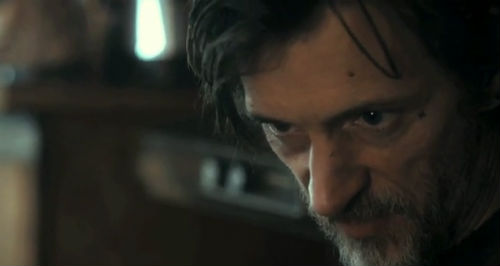
John Hawkes as Teardrop in Winter’s Bone

Movie Review: Liberal Arts–Light but Enjoyable

David Foster Wallace famously gave a commencement speech at Kenyon College in 2005. The speech –Wallace’s only know public speech–had been printed and reprinted, e-mailed and downloaded time and again, and now is published as the book, This Is Water: Some Thoughts, Delivered on a Significant Occasion, about Living a Compassionate Life.  Wallace, whose magnificent and enormous novel Infinite Jest is perhaps for the millennium generation what Gravity’s Rainbow was for the Viet Nam generation, is known for his intricate plots and subplots, his baroque sentences, his numerous footnotes, and his expansive and enormous intellect.

Well, Kenyon College and Wallace meet up again in the 2012 comedy Liberal Arts.  Actually, Wallace isn’t there physically, but Infinite Jest is, and the novel and its author play a significant part in a poignant subplot about a depressed, genius undergraduate. In fact, towards the end of the film, the hero tells the hospitalized boy to put down Infinite Jest  (he has already read it three times) and pick up one of the Twilight books! 

Kenyon College, on the other hand, is very much visible–and looks torn right out of a college brochure. The leafy campus, the quaint town, the rural surroundings, all make Kenyon look like a movie set for the perfect college.  However, although Kenyon is one of the more illustrious and demanding liberal arts colleges in the U.S., it offers up a pretty “easy-A” with Liberal Arts. Nothing too difficult, too taxing , or too subtle.

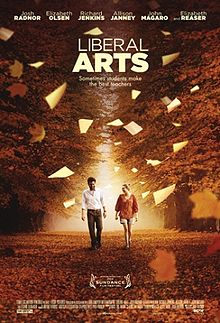
The film tells the story of Jesse (Josh Radnor), a bookish and sensitive admissions officer at a New York City college (read NYU) who is dissatisfied with his job and his life. When he is called back to Kenyon to attend the retirement party of one of his favorite professors (Richard Jenkins), he meets Zibby (Elizabeth Olsen), an undergraduate studying Improv Theater.

Elizabeth Olsen and Josh Radnor in Liberal Arts

The 35-year old Jesse and the 19-year old Zibby hit it off immediately and enjoy each other’s company as they wander around the bucolic campus. When Jesse returns to New York, he begins a “pen-pal” relationship with “Zibby” that is sweet, literate and full of hope.

However, when he returns to visit her, the differences in their age–and life experience–plays very much on his mind. (To me, since the actors do not seem all that greatly separated in age,  the age difference did not really seem all that jarring.)  Her attempt to bed him on this second visit is the moral center of the movie.

There are some wonderful performances–Allison Janney as an ice-hearted professor of the British Romantics is marvelous and Zac Efron as a chorus-like sprite that pops in and out of the story is charming and enigmatic. And the lead characters are very likeable.  The camera work between Ohio and New York is beautiful and perfectly captures the shift in energy that Jesse feels in moving between the two places. And the subplot with the depressive undergraduate is interesting enough, if rather slight. (It might have made a better movie in itself.)

In all, the film is concerned with life and its trajectory, with love and its various shadings, and with contentment and its frequent elusiveness. It is funny and literate at times, but for the most part it is a simple story, simply told.  Liberal Arts could have been a much weightier film–but that’s not the film the director chose to make.

I can’t imagine David Foster Wallace liking it. There isn’t much layering here, not much that he could footnote.  It would  have made a very slim novel.

The house that Barnes built…now relocated

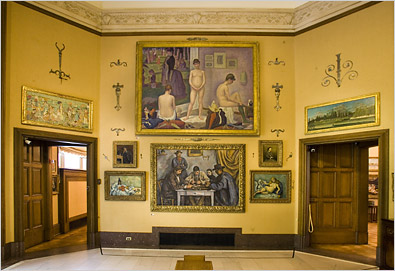
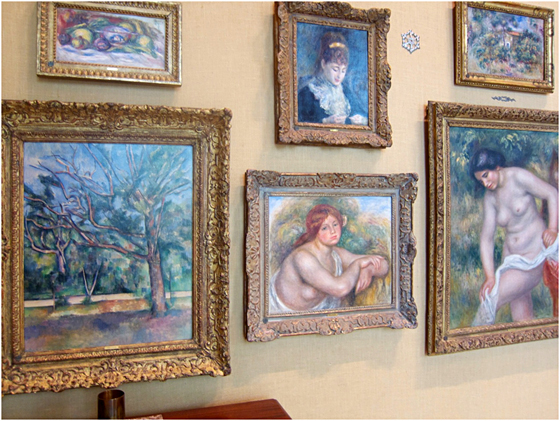
Yesterday I went to the new home of the Barnes Collection.  The building is light and airy and relaxing and peaceful.  And the art there is second to none. Even to the least knowledgeable visitor, there must be ten paintings in each room that are recognizable.  In many ways, it is like walking into a primer of Modern Art.

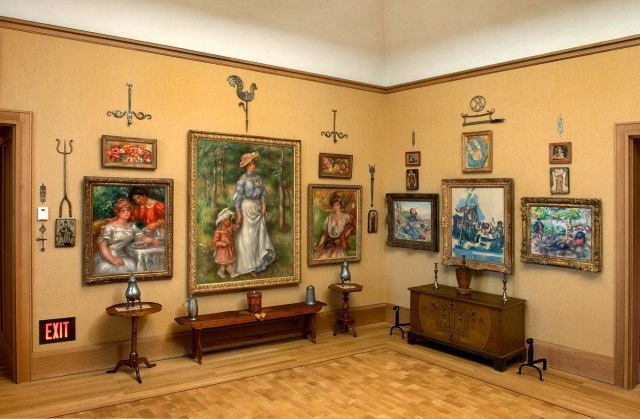
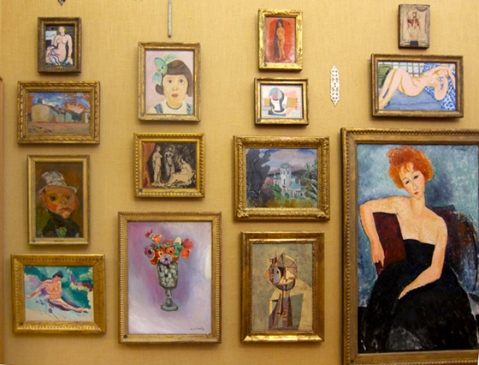
To give you some idea of the scope of this collection, it holds 181 Renoirs, 69 Cezannes, 59 Matisses, 46 Picassos, 16 Modiglianis, 11 Degas,  7 Van Goghs, 6 Seurats, as well as numerous works by Manet, Utrillo, Demuth, Prendergast, de Chirico, Gauguin. And shoring up these masters is the odd El Greco, Rubens, or Titian.  There is also a large array of African sculptures, modernist textiles, ceramics, American folk art, Pennsylvania-Dutch cabinetry, and a large assembly of ironwork that, like the delicate chain of a rosary, seems to link the paintings together in each room.

And all in a private collection!

There are so many stories behind the Barnes Foundation. Having amassed what is arguably the most famous personal collection of modern art in the world, Albert C. Barnes had willed that his collection remain at his residence in  Merion, a suburb of Philadelphia. He had stipulated that the collection would be open to the public for no more than two hours a week and that reservations had to be made two-weeks in advance. He wanted the works to be used solely by artists, students and educators for study, and so the paintings  were not to be loaned or reproduced. After what would be the first of many legal challenges, these stipulations were first amended to two-and-a-half hours a week  and visitors were limited to 500 people a week.

(Originally, Barnes wanted his collection for art students and laborers only, and he had little time for the rich and celebrated. In a room outside the galleries, there are documents from Barnes’ life. One is a letter to the automobile tycoon,  William Chrysler, stating that he must refuse his request to visit the collection because at the moment he is practicing goldfish swallowing and can not be bothered!  Another form was a bill of sale for eight Picasso’s. He had spent $1490.00)

In 1992, the Barnes Foundation was in some straits, the house itself needed some repair, and after a great deal of legal wrangling much of the collection went on a world tour. For the first time, the collection, which had been so limited in the numbers of people who had actually seen it, was now being viewed by millions in cities around the world.

But the tour still did not bring in enough funds.  When the foundation tried to extend its hours, the local municipal government balked, and after several years of suits and counter-suits, of bitter and arcane legal wrangling, it was decided that the collection would be moved to a new location on Philadelphia’s Benjamin Franklin Parkway. The move was (and still is) highly controversial and was the subject of the 2009 documentary, The Art of the Steal.

But to be honest, the museum is beautiful.

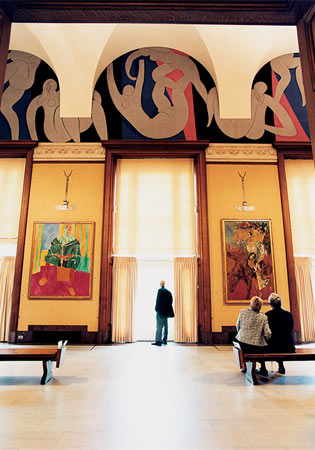
The new location recreates the rooms of Barnes’ home to the finest detail–baseboards the exact height, wall paper the exact texture, paneling the exact wood–and encases them in a building that is peaceful, modern, and relaxing. And the bonus is that now so many more people are now able to see what was before limited to such small numbers.

How impressive is Barnes’ collection? It literally takes one’s breath away–you walk into the first room and you gasp! The sheer number is overwhelming. Above the windows of the first room are the three large panels of Matisse’s Dancers. You are in a room with several Picasso’s and yet that is not where your eyes go immediately.

The paintings are hung with precision and deliberation–two small Renoir landscapes will surround a large Renoir portrait which will contrast with the Matisse portrait above it.  And the ornamental ironwork that is placed throughout reflects the patterns, shapes and themes of the pictures they  accent.  For instance, a sinuous iron bar  echoes the curves of an odalisque by Cezanne.

A single day is rarely sufficient to see any museum, and this is truly so with the Barnes. A person could easily spend an entire day in one room and feel sated. (And one could certainly post an entire blog on any single room…if not on any single painting.)

While so many of the paintings are very familiar and are such a part of Western culture, they were not so when Barnes first bought them. (The $1490.00 that he spent on the eight Picasso’s attests to that!)  He had traveled to Europe on his honeymoon and had befriended Leo Stein, who with his sister Gertrude had become such great patrons of Picasso and Matisse. Barnes then commissioned his high-school friend, the artist William Glackens, to Paris to buy art for him. Barnes trusted him completely, and Glackens purchased the first twenty paintings of the collection.

Another story, tells how Barnes himself went into one particular gallery, liked what he saw and bought 52 paintings. Could you imagine a gallery owner today with that sort of sell? Could you imagine the cost?  But aside from having money, Barnes also had an extraordinary eye–and an extraordinary vision.

Barnes had made his money by inventing a chemical preparation used to disinfect the eyes of  newborns. He spent his money on opening our eyes to the glories of twentieth century art.

Today, despite the wrangling and the bad blood, despite the legal pyrotechnics and the extra-legal manipulations, the Barnes Foundation is nevertheless one of the great centers of modern art–and the controversial relocation is truly a masterpiece.

And more importantly: amid all this hubbub, amid all the controversy, it is a place of extraordinary peace and beauty.

It’s not a bad place to spend a Sunday afternoon.