Quibble with electronic publishing, part 2:

♦ ♦ ♦ ♦ ♦ ♦ ♦ ♦ ♦ ♦ ♦ ♦

Who would have thought it?

Well, I guess quite a few people.  Yesterday, I posted a piece worrying about the future of writings “published” on the Internet and used as an example the disappearance of two particular stories of mine.

I said that I knew that nothing ever really disappears from cyberspace, but asked, “Would the common man have the tools necessary to recover those materials that are missing?”

Apparently he does.

Sure enough, someone a lot cleverer than I am went and found one of the stories I had cited. Three cheers for Gerry Bracken. He said the tool he used was the “Wayback Machine” (see picture above) and I know I definitely don’t have one of those.  Anyway, he found the “Dublin work-shopped” version of the story “Nadja and the Dream of Teeth.”  I don’t remember the difference between this and the final version, but it’s been a long while since I read it, so that was fun it itself.

Anyway,  I posted the first few paragraphs below.  If you’re interested, the rest of the story is at

http://web.archive.org/web/20040102060543/http://www.dublinwriters.org/eacorn/EA13/bohannonstory.htm

Again, thank you Gerry Bracken. It’s been a good day all around.

from “Nadja and the Dream of Teeth”

At the time there are three distinct women. Two orbit around his person like meteors that arrive and disappear, pendulous and pending, with the rigidity and regularity of the calendar. They are dark and light, one and the other. The fair one is more than fair. Her skin is pellucid. Thin webs of capillaries and veins map her arms, her breasts, the small of her back. The other, the dark one, is Mediterranean, raven-haired, Homeric. She smells of cigarette smoke and has hands older than her age. There is a husband somewhere. Cruel. Oafish. He keeps her meanly and she stays. The third is Nadja, herself. She is his earth, past which the others streak.

“I have made you an appointment,” she tells him. “At half-nine tomorrow.”

He presses his fingers to his face, toward the eye socket. The pain is there, where he touches. Not in the tooth itself, but on his face. Always he has avoided dentistry. But now, she has made the appointment and, when the time comes, she will drive him there.

The two others, the dark and light ones, we shall call Mim and Mam.

Mim keeps exotic animals. Large brilliant birds, ataractic reptiles, silky-haired dogs. She walks a wolfhound, Erté-like, on a tartan leash, its dusky coat shimmering in the sunlight. She wears black always and walks with catlike grace, taut muscles rippling effortlessly and surely. On certain evenings she will stride into McLoughlin’s and the big dog will stay at her feet through two and sometimes three gin-and-tonics. The dog is said to be gentle.

The other one, the dark one, he calls “Calypso,” and when she kept him, the moment seemed infinite and timeless. She fusses about him yet, fusses about what he eats and drinks and thinks, pleasuring him with a maternal concern that he had long forgotten. To his soul, dusty and cretaceous by nature, she brings the mist of the sea, the juices and oils of the fields, the energy of the sun. She gives him hope and calls him her “Father Confessor,” for she too has her secrets, her venom, her lusts. He never touches her but for her hand and her crone-like fingers.

It is to Nadja however that he has decided to remain grounded, connected. For her, too, he has given up the drink, the three-o’clock whiskeys, the bottle of Beaujolais at dinner, the Armagnac before bed. Of course, he has lied. He is always aware of his duplicity, for he said, in a moment of self-incriminating fury, that she would never again see him with a drink in his hand. And he keeps that promise, to be sure. But he continues when she is not there, when he is alone, when she is away. …


A quibble with electronic publishing

I’m a little worried.

Just a little worried.

The majority of things I’ve had published are in print. They  haven’t earned me a fortune–five dollars here, twenty dollars there–but a least I have a copy of them. Actually, two copies of them, because most of the ” legitimate” small journals pay in copies. They publish your story, poem, essay and pay you with two copies of the issue in which you appear. Two copies placed with the others in a chest at the foot of my bed.

And then along comes the Internet. Instant gratification. Electronic submissions. Electronic responses. Usually much quicker than traditional ways.

The best story I think I’ve ever wrote was published on line. “Nadja and the Dream of Teeth” first appeared through the Dublin Writer’s Workshop in the journal The Electric Acorn.

Then it was published electronically by The Richmond Review (UK). The editor at The Richmond Review was wonderful. She asked questions, made good suggestions, and, overall, made me tighten things up.  All through e-mails. From across the pond. This was the internet at its best.

And then it appeared electronically. It was beautiful. Nice layout. Clean font. Well done. I was proud of the story and proud of its being out there.

Now several years later, the site is down. Just a blank white page. Try it. Google “Richmond review uk” and you’ll find the link.  And then a pure white page. Where is my story? Not there. Not archived. Nowhere. And it was a legitimate journal!

Sort of the same thing with another story– “Pierced.” Except the journal it appeared in didn’t disappear; it sold its domain name to a Japanese company. Try to find my story and you’ll be staring at a beautiful chrysanthemum surrounded by Japanese writing. I am pretty sure that it is not my story translated into Japanese.

So. No big deal. Two short stories that meant something to me but certainly not to anyone else. Vanished. Pouf! But what if this was important material? Is there a fear that important things might simply disappear after a given time?

I know the saying that nothing ever disappears in cyberspace, but will future researchers, historians, students all have the tools necessary to recover those things that have?

Granted there is much that is superfluous, so much that is ephemeral on the Web. Much of it–my own scribblings included– really doesn’t deserve a long shelf life. But, by caching materials away so easily are we also tossing away things of lasting value.  I don’t mean the works of a future Shakespeare or a document of “Declaration of Independence” import.  I mean things like the novelist Rick Moody’s music reviews on Rumpus or Margaret Atwood’s book reviews for The Guardian or the Scottish poet Robin Robertson’s powerful reading of “At Roane Head.”  My fear is that this stuff–which is important stuff, important aspects of our culture, glimpses into who we are–will someday disappear.  Without a trace.  Without record.

Is it the nature of blogging or on-line writing in general to be ephemeral? Is that what is the draw? Do we read it not expecting ever to go back to it.  I don’t know.

But it does worry me at times.

Summer Reading

Image

It is traditional in the U.S. for schools to give students a list of books to read during the summer.  The concept is twofold: one, keeping a student’s mind engaged while absent from most intellectual interaction; and two, trying to excite a student to the pleasure of reading.  So the trick is to find titles that are both stimulating and enjoyable and thoughtful.

So in the school I work at, the “Summer Reading List” has just been published. Here are the titles:

For 9th Graders:

The Hunger Games by Suzanne Collins
Enders’ Game by Orson Scott Card
Ishmael: An Adventure of Mind and Spirit by Daniel Quinn

For 10th Graders:

Four mandatory short stories by Nathaniel Hawthorne and four other Hawthorne stories of the student’s choosing.
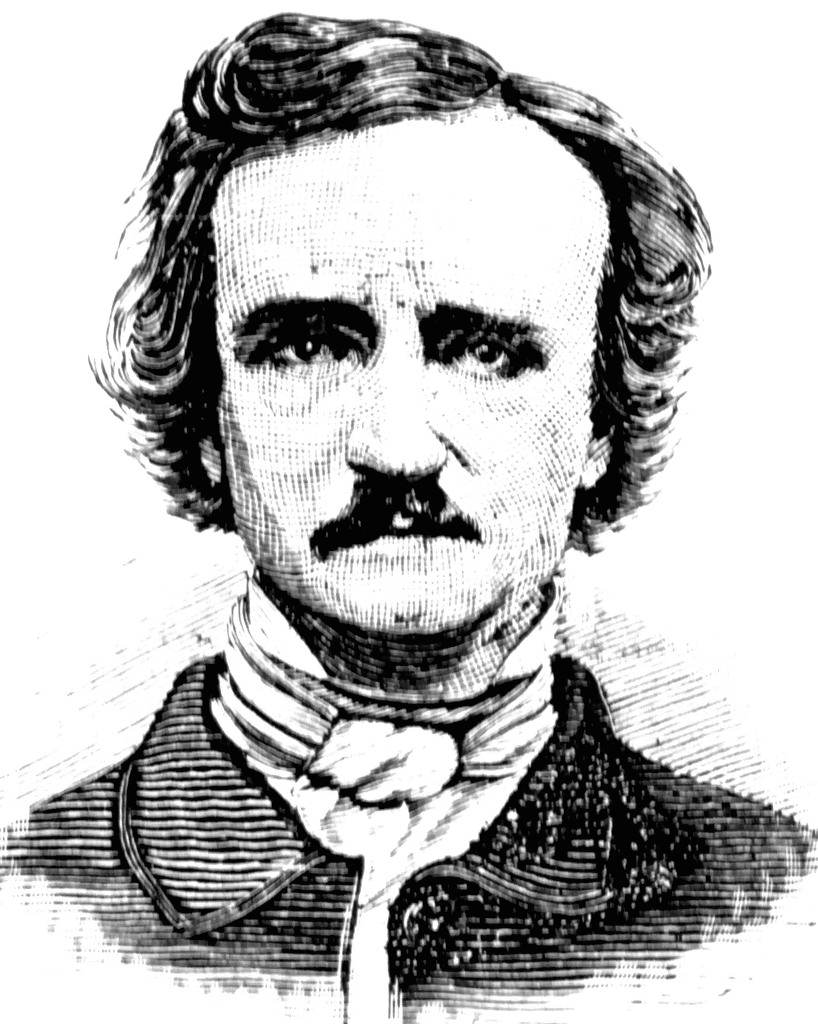
Four mandatory short stories by Edgar Allan Poe and four other Poe stories of the student’s choosing.

For 11th Graders:  There are two levels of books. The first level has a wide choice. They MUST read the first two and then choose ONE of the remaining six:

Don’t Look Now: Selected Stories of Daphne Du Maurier   by Daphne DuMaurier and Patrick McGrath
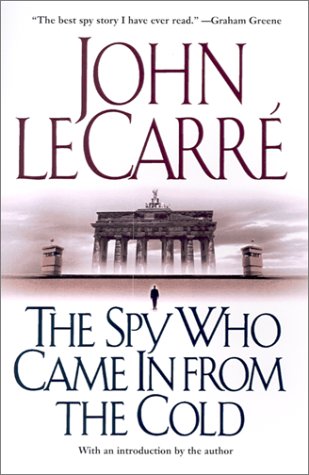
The Spy Who Came in from the Cold by John Le Carre

Here’s Looking at Euclid by Alex Bellos  (HOW GREAT A TITLE IS THIS!!!!!)
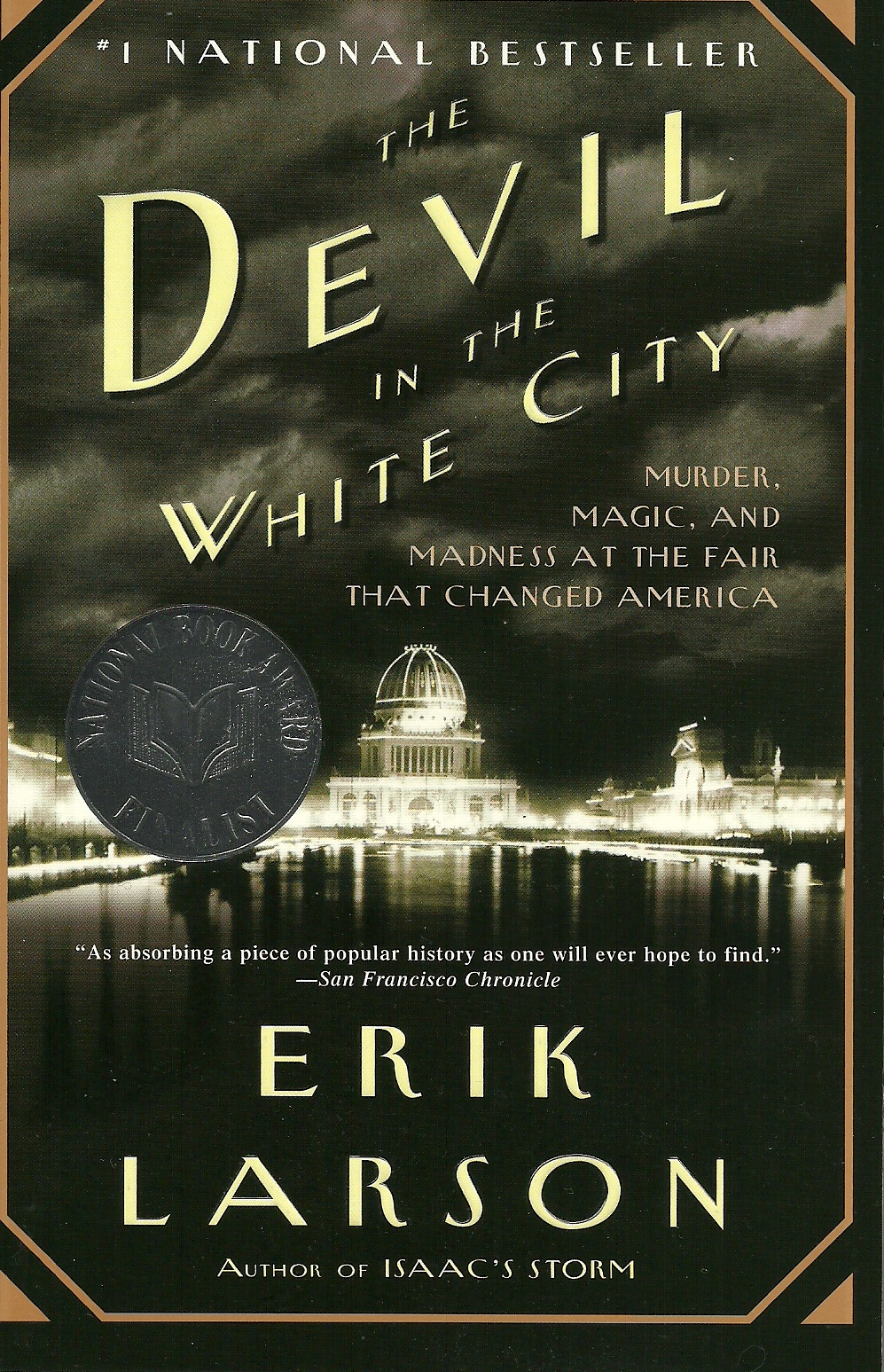
The Devil in the White City  by Erik Larson
The Omnivore’s Dilemma by Michael Pollan
Mutants: On Genetic Variety and the Human Body by Armand Marie Leroi
The Professor and the Madman by Simon Winchester
The Disappearing Spoon by Sam Kean

The other group of 11th graders read these:

Watership Down by Richard Adams
HIGH FIDELITY by Nick Hornby
Freakonomics by Stephen Dubner and Steven Levit

Those in 12th Grade read:

Zeitoun by David Eggers
Like You’d Understand Anyway by James Shepherd

Those in Advanced Placement 12th Grade have a large list to choose from. Some are mandatory and some are choice, but they end up reading 5 titles in all (and for one, reading the book AND watching the film.) They are:

Ragtime by E.L. Doctorow
The Wonder Boys by Michael Chabon
1984 by George Orwell
Do Androids Dream of Electric Sheep? by Phillip K. Dick
On the Beach by Nevil Shute
A Plague of Doves by Louise Erdrich
Brighton Rock by Graham Greene
Player Piano by Kurt Vonnegut
The Dew Breaker by Edwidge Danticat
Demian by Hermann Hesse
The Hours by Michael Cunningham
Obasan by Joy Kogawa

King Lear by William Shakespeare and the 1985 Akira Kurosawa film Ran
Educating Rita by Willy Russell and the1983 film by the same name
The House of the Spirits by Isabel Allende and the 1994 film by the same name
The Commitments by Roddy Doyle and the 1991 film by the same name
High Fidelity by Nick Hornby and the 2000 film by the same name
Equus by Peter Shaffer and the 1977 film by the same name
The Day of the Locust by Nathaniel West and the 1975 film by the same name
The Color Purple by Alice Walker and the 1985 film by the same name
Beloved by Toni Morrison and the 1998 film by the same name
The Good Earth by Pearl Buck and the 1937 movie by the same name
The Reader by Bernhard Schlink and the 2010 movie by the same name

I must admit, I haven’t read (or watched) all of these titles, but I have read most. It’s a pretty eclectic list…and certainly stimulating. I have my own favorites–Zeitoun for anger, The Commitments for fun, The Hours for tears, The Color Purple for the extraordinary… I could go on, but won’t.  Have fun. Choose something for yourself, if you have the time.

So whether it’s been one year since you’ve been out of high-school or fifty-one years, give the list a look over and maybe you’ll find something to get you through the hot summer days that are already well on their way.

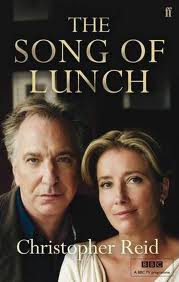
Poetry on TV: The Song of Lunch by Christopher Reid

Farewell to long lunches
and other boozy pursuits!
Hail to the new age
of the desk potato, …

Sometimes, though, a man needs
to go out on the rampage,
throw conscientious time-keeping
to the winds,
kill a few bottles
and bugger the consequences.

Ah, I too miss those boozy lunches. I worked for more than a decade in an in-house advertising agency, and some of our Friday lunches were both epic and legendary.  But I ultimately left advertising for the more sedate, sober world of academia–or at least the more sedate, sober lunches of academia.

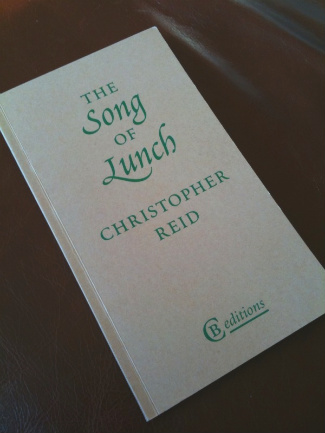
The man who is lamenting the lost tradition of long lunches above is the rather bitter and sarcastic subject of Christopher Reid’s The Song of Lunch. Yet on this particular day he sticks a note on his computer screen saying that he is headed out to lunch and that indeed it is going to be a long one.

Probably, unwisely, he has arranged to meet an ex-lover for lunch at one of their old haunts. He, a copy-editor at a famous publishing house; she, the wife of an extremely successful novelist, living in Paris. The novelist is also the man she left the narrator for.

He isn’t sure what he expects from this rendezvous but little of it goes the way he hopes.

Lunch has never been more poetic, or sexier, or frustrating.  The dance of tension and attraction between the two begins immediately.

There! she says, and smiles
Lips, eyes, eyebrows
and the new lines in her forehead
fill out the harmony.

Here! he replies.

She has just entered with “There” and he counters with “Here.”

He bemoans the fact that “their” restaurant has changed so much in the fifteen year interim: the menu features:

pizzas by the yard.
More pizzas than there should be.
And too much designer pizazz.

He turns it over:
choose the right wine
and have it ready breathing
for when she arrives.

There’s a mid-price Chianti,
which won’t come plump
in tight straw swaddling,

byt will do for auld lang syne.

In fact, it is for the “auld lang syne” that he is here, crumpled by the present, dashed in his literary hopes, and obsessed with a long-gone love.  This lunch is very much not the best idea of his.

But she on the other hand is charming.  Personable, open, interested, determined to enjoy the day.  But he cannot. When she asks about his life he goes on a rant about modern publishing:

Confessions of  Copy Editor ,
chapter 93.
It;s an ordinary day
in a publishing house
of ill repute.

Another moronic manuscript
comes crashing down the chute
to be turned into art.
This morning it was Wayne Wanker’s
latest dog’s dinner
of sex, teenage philosophy,
and writing-course prose.

In contrast, she is accepting and pleased with her life as:

Me? Oh, the good wife,
and loving mother.
That keeps me occupied.
I’ve no complaints.
And Paris is a fabulous city.
You really should visit.

(He has by the way, visited. Stalked her a while back but lost the nerve to ring the bell when he was at her door.)

Throughout the lunch, he observes her every move. He watches her daub her mouth with a napkin,  slice into her ravioli, ask the waiter for advice. And all of these observations are described in a rich language filled with a keen ache, for he remembers every whorl of her knuckles, every dilation of her pupil, every crinkle of her lips.

To deal with his ache, his confusion, his lust, he drinks.  Far too much.  Much more than she.

She had arrived at the lunch full of good will and charm, but his sarcastic, bitter demeanor pushes her away.

But, it is a narrative poem–it tells a story–so I won’t spoil the ending.

Now, in 2010, the BBC did something extraordinary.  Rather than digging in the vaults of the classics (there is an endless list of Dickens and Austen productions) or dramatizing the latest Scandinavian thriller or Scottish mystery, they decided to do something quite different.  They decided to dramatize a contemporary work of poetry.  And they did it well.

The BBC2′s production of The Song of Lunch–made to celebrate National Poetry Day in Britain– was genius simply in the choice of the actors.  Alan Rickman and Emma Thompson.  For who can better play a put-upon man, dour and drunken, and rising with lust and regrets better.  I cannot think of anyone else.  And Emma Thompson, literally shines in the role–literally that is. In one scene where Rickman is looking at her through his half empty wine glass she is glimmering.  There is a fresh aura of rightness about her that works in perfect contrast to the curmudgeonly Rickman.

The Song of Lunch is a strange one for me, for I saw the film production before I read the book.  In fact, it was BECAUSE of the dramatization that I got the book. “Making words come alive” is such a cliche, yet in this case it is very much true.  The tiny narrative of Reid’s is served quite well when animated by Rickman and Thompson.

I’ve read the poem several times now, finding something new to enjoy each time.  I You-tubed the BBC production and watched a few scenes, but the BBC came in and took certain “chapters” off, so one loses the continuum.

I do remember those long boozy lunches.  Though I wish at the time I was as observant as Christopher Reid.  His The Song of Lunch is as rich as the carpaccio and pumpkin ravioli that were ordered for appetizers and as heady as the grappa that finished the meal.

MIND-BODY Problem or “who is this person stuck inside my sick body”?

I have been sick for the past five days.  Sick enough that I have come home from work every night and gone straight to bed.  Sick enough that I am existing on juice, tea, aspirin and kleenex. Sick enough.

This morning I said to someone “I don’t even want to be inside this body anymore.” Not really sure what that meant, but it got me thinking.  Who was talking there?  Who is this “I” that feels itself a guest inside this “body”?  Of course, I couldn’t let it go from there.

I had to look for answers.

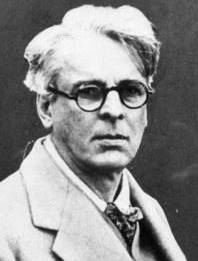
The questions are hardly new: ancient Greeks and the early Hindu yogis each grappled with the Mind-Body Problem.  In the modern world, it was Descartes on one side and Spinoza on the other side of what became contrasting points of view.  Descartes and the Dualists believed, in essence, that the mind and the body were separate entities. This seems to jibe with the Yeatsian view in yesterday’s post that something existed apart and before the body was made.  Of course, as philosophers are wont to do, the Dualists have splintered into various groups as well.

Spinoza and the Monoists believe that the mind and the body are one. Our feeling that these two entities are distinct is simply the properties and emanations of the brain. With recent advances in neuroscience, brain-mapping, psychology, etc., it appears that the mononist position has been gaining strength. Yet it too has broken into several splinterings. The most basic is that between reductive and non-reductive.  The reductive believe that ultimately all mentality, all mindfulness, will be able to be explained through a scientific understanding of our physicality.  The non-reductive agree that all there is to the mind is the brain and its functions, but believe that its functions cannot be “reduced” to the parameters and terms of physical science.

This is the scan of a normal brain. The question, to me, is where did they find one.

So all of this is scary stuff.  What does it mean if our “self” is really just a creation of the physical firings and synapses of our brain in conjunction with the countless other functions going off –or awry–in our body each moment.  If our “self” is truly just a construct of our brain, then that construct can be manipulated.  Don’t think so?  Advertisers, politicians, behaviorists do!  It is, after all, their job to make you do, buy, think, act in a way that you did not necessarily consider before. Their livelihoods are predicated on your “self”  being manipulated.

I know that at the moment my own body is misfiring–sinuses are clogged, limbs are achy, head is pounding, throat is soar, lungs are tender.  Yet who is “the self” that is getting fed-up at that body, fed-up at the slow pace of recovery.  It would seem that I am dealing with dualism here.  And yet, intellectually I  side with the monoists.

I guess, my little old brain has simply been formed in a way that tends to have these thoughts while my body hits these speed-bumps.  It’s all part of the package.

“Before the World was Made”

“The Yale philosopher Shelly Kagan … manages to raise some interesting and subtle concerns about …notions relating to the question of what’s really bad about death, including this one: Why do we regard no longer existing (post-mortem nonexistence) as worse than not having existed before our births (prenatal nonexistence)? And are we wrong to do so?” 

“The Opinionator,” New York Times, May 16, 2012.

I love this question.  I have thought of it before, and it gives me comfort. For it makes perfect sense to me.  I wonder if Mr. Kagan is aware of the Yeats’ poem, “Before the World was Made.”  I would imagine he is. I know I thought of it right away when I read the article.

    Before the World was Made

If I make the lashes dark
And the eyes more bright
And the lips more scarlet,
Or ask if all be right
From mirror after mirror,
No vanity’s displayed:
I’m looking for the face I had
Before the world was made.

What if I look upon a man
As though on my beloved,
And my blood be cold the while
And my heart unmoved?
Why should he think me cruel
Or that he is betrayed?
I’d have him love the thing that was
Before the world was made.

For here, Yeats too is looking at what Kagan calls “prenatal nonexistence”–though Yeats prefers to think of it as “prenatal existence.”

Now Yeats is working in a spiritual cosmology quite different from that which the Yale philosopher is dealing with.  Yeats was always susceptible to spirituality and spiritualism…mysticism and the occult.  (Adrienne Rich famously called him a “table-rattling fascist.” Click here for Evan Boland’s essays on literary antagonisms.) Nevertheless, he was very much interested in concepts of a soul. He believed–through a complicated mythology of his own making, explicated in his book The Vision–in an individual, social, and civilization-wide reincarnation or continuance of the soul.  And so through this series of Yeatsian cycles we have it: a “pre-natal” AND “post-mortem” existence, as the philosopher says.

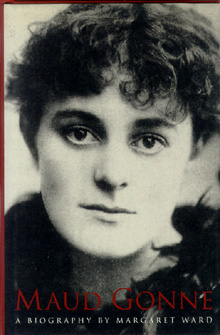
Maude Gonne

And yet, there is also something else going on in the poem that is not as deep, not as cosmic, not as “philosophical.” This is not a cosmic dance taking place in front of the mirror.  It is that old familiar dance of seduction and romance.  For who is the speaker sitting in front of her vanity? Has Yeats returned to musings on his old beloved Maude Gonne? Is he thinking of her daughter–to whom he once proposed having been rejected for the umpteenth time by Gonne? The poem was published in 1933 when Yeats was 68 years old.  The following year Yeats had the Steinach operation performed–a procedure of inserting animal glands into the body in order to increase testosterone production. Good old Yeats–he was now 68–was not giving up on this existence…and at this time was carrying on several romantic affairs with much younger women.

The poem itself appeared in the collection, The Winding Stair, and was one of twelve poems included in a section called “A Woman Young and Old.”  If the speaker is a woman where does she fit in that continuum?  Is this a young woman relatively new at the game?  Or a more experienced woman, who could look on any man “as though on my beloved”?

And what is it she would have him love?  What existed “before the world was made”?  For the philosopher Kagan, the answer is nothing.  For Yeats it is something large, something essential.

As an aside, I knew that Van Morrison had recorded a song version of the poem.  I also knew that Mike Scott and the Waterboys had just put out an album, An Appointment with Mr. Yeats, on which the poem appeard. But I just learned that Carla Bruni–the former first lady of France–had also recorded the song.  I don’t know why, but I find that amusing.  Anyway,  here’s Van the Man’s performance of Yeats’ “Before the World Was Made.”

Neil Young, Americana and me

On Friday, I received an e-mail from an old friend.  He had been listening to public radio and they had a program called “Old Music Tuesday.”  Here’s what the reporter, Robin Hilton said:

I haven’t kept an official ticker, but if government agents kicked in my door and forced me to pick the one album I’ve listened to more than any other, I’d have to say Neil Young‘s Everybody Knows This Is Nowhere. It came out 43 years ago this week.

The album was 43 years old that week (Yikes!). Though, I too can likely claim it as the album I played most. My friend linked me to the page–

http://www.npr.org/blogs/allsongs/2012/05/15/152748432/old-music-tuesday-neil-youngs-everybody-knows-this-is-nowhere?sc=nl&cc=sod-20120517

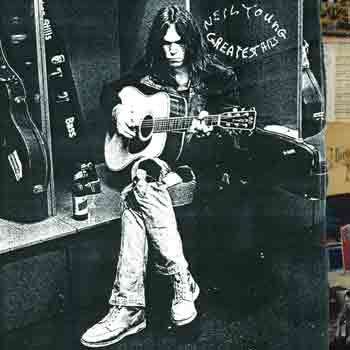
And then he said that he thought of me when he heard the show. He stated that it was I that had turned all our friends onto Neil Young.  I don’t know if that was true, but I do know I very much wanted to be him. I did a credible impersonation and knew all his songs on the guitar –although I never quite mastered  the lead jams. I had a female friend–Sue Shelley–who was a great seamstress and who patched my jeans just like Neil’s with upholstery and corduroy and quilting.  At a festival, a friend’s band invited me on stage and we did “Down By the River.” And I remember once going to a friend’s older brother’s party–whoo-hoo! we were hanging with the big boys–and I played the entire “Last Trip to Tulsa”–all 10 minutes of it–and felt that certain feeling you get as a teenager when the older guys validate you.

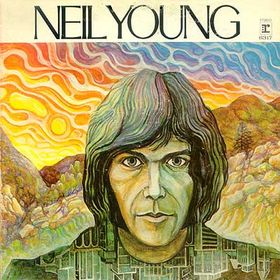
First solo album, with the 10 minute “Last Trip to Tulsa”

It was much later, after the Harvest album that another friend said that Neil Young was responsible for thousands of bad guitar players in America.  I’m not sure if he was alluding to me, but I got his point.  Every beginner seems to start with the basic E-minor, D sequence of “Heart of Gold.” But I argued that the simplicity does not take away from the beauty of the songs–it is part of the package, part of the appeal.

I went through them all. Followed the players in their own ventures: a young Nils Lofgren who played on the After the Gold Rush album, formed a exciting band named GRIN before moving on and becoming Springsteen’s guitarist;  the various incarnations of Crazy Horse, whose first album was the soundtrack to so many great moments; the irrepressible producer, Jack Nietzche who went on to win an Oscar for An Officer and a Gentleman and being nominated for his music for One Flew Over the Cuckoo’s Nest.

Anyway, I will confess, Neil was an obsession. I had every Buffalo Springfield album, and followed the many bands that broke off from there.  The same with CSN&Y.  But it was always Neil that was my focus. (Although a girl once dated me because she said I looked like Steven Stills. Probably, not the best foundation for a relationship, but I ran with it for as long as I could.)

And aside from his music, I admired his integrity. He made albums that pushed music every which way. (He was once sued for an album that the record company felt didn’t sound enough like Neil Young. This was the same year a record company sued John Fogerty for sounding too much like his old band. Ah, the suits, you gotta shake your head some time.)  He made rockabilly and electronica and country and good old rock-and-roll. He got involved in personal and political causes; founding Farm Aid in support of small farmers, as well as establishing the Bridge School for children with verbal and physical disabilities. He also leads the Bridge Festival each year which brings along some extraordinary performers and is a large source of fundraising and awareness for the project.

His performance of John Lennon’s “Imagine” shortly after 9/11 on a televised benefit was beautiful and perfect for the situation. Watch it here:

Under the pseudonym, Bernard Shakey, Neil as directed or co-directed a handful of films and produced even more. The recent film CSN&Y/Deja Vu–which centered on CSN&Y and their 2006 Freedom of Speech tour–was a reminder of Young’s commitment to the small man when set up against the larger, darker forces.

It is this film-making penchant which is front and center now. Having received that e-mail announcing the 43rd anniversary of Everyone Knows this is Nowhere, another friend, out of the blue, pointed me towards a new album that is coming in June, Americana. Neil is back with Crazy Horse and they have recorded an album of Americana songs: “Old Suzanna,” “Darling Clementine,” “She’ll be Coming Around the Mountain, ” etc. As of now, he has released three vide0s from the album–not footage of the band playing, but archival film of the rural poor, the ante-bellum rich, D.W. Griffith.  The films themselves are small jewels.  And the music is rocking.

Anyway, here’s the video from “Old Susanna.” Enjoy it:

Clockwork Orange and City of Bohane

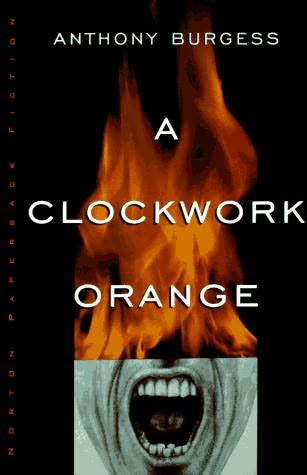
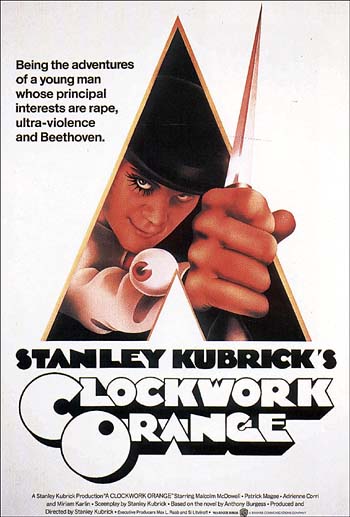
The Guardian had an article today noting the 50th Anniversary of Anthony Burgess’s A Clockwork Orange. Mind you, it is the anniversary of the book not Stanley Kubrick’s iconic movie, which has taken on a life of its own.

I first read the novel when I was seventeen. I read it a month later when I learned there was an edition with a glossary in the back. The glossary didn’t enhance the read that much; everything could be inferred from context  without too much trouble. (I had heard the glossary was only in the American edition, but I am not positive of that.) Anyway, what I remember most was the language: it was playful, edgy, smart, and alive. It was a mixture of joycean word play, street jive, cockney, rhyming, Slavic slang. And it was what set me off reading a lot of Burgess, from the Enderby novels to the Majestic Napoleon’s Symphony to the various autobiographies.

The movie was another thing.  I was hitch-hiking across Canada from Vancouver to Toronto and winter was coming on a lot earlier than it came where I was from. It was only the last week of August, but we woke up under a thin sheet of snow in Regina.  Earlier, to stay out of the cold, and since nothing seemed to be coming along Canada’s Highway 1, we went into the town of Regina and bought tickets to see Kubrick’s A Clockwork Orange. It was very stylish and engrossing, with a narrative that I already knew.  I don’t remember now being struck by the ultra-violence. I do remember the music and the Skinner-like experiments and the tragic ending.  

But anyway, today, in their piece on the 50th anniversary of the book, the Guardian said this:

Fifty years ago today, Anthony Burgess published his ninth novel, A Clockwork Orange. Reviewing it in the Observer, Kingsley Amis called the book “the curiosity of the day.” Five decades later there is still nothing like it.

I beg to differ.

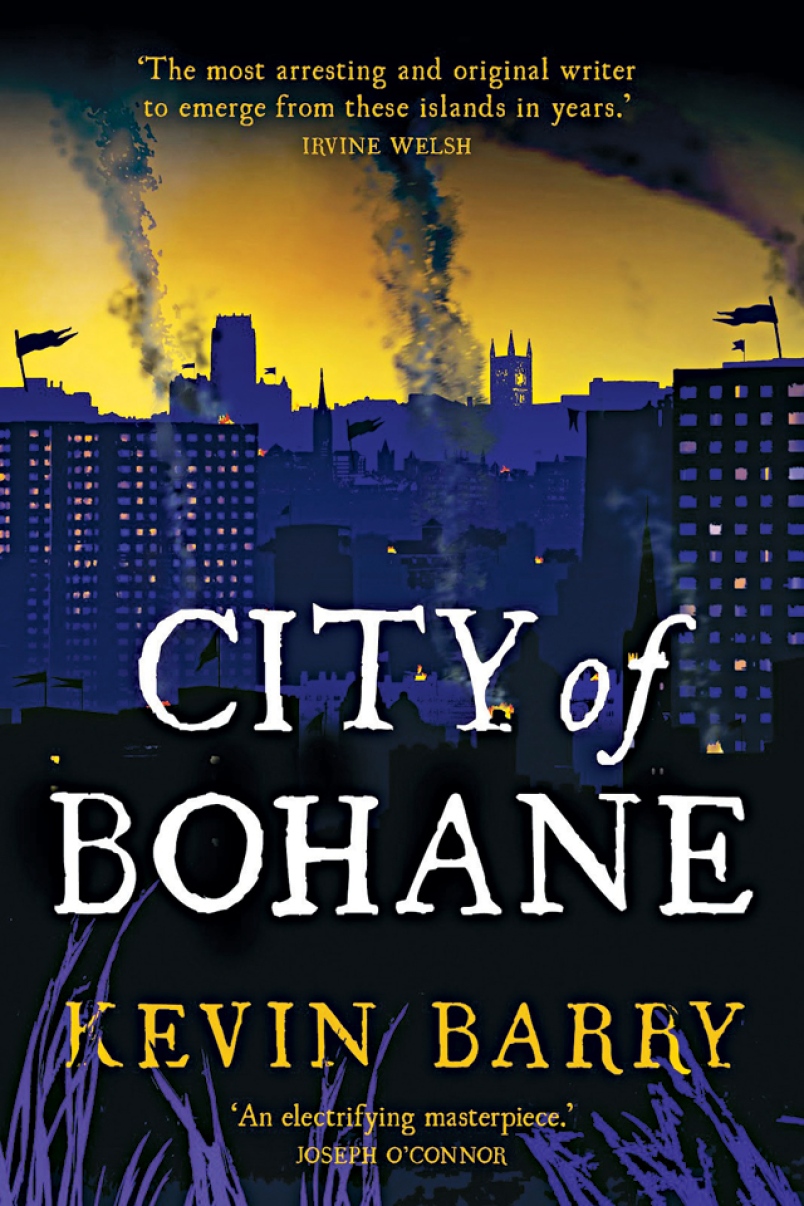
Kevin Barry’s first novel, The City of Bohane is channeling Burgess big time.  Set in a dystopian future, in what could be an unrecognizable Dublin of 2053, it is full of violence, sex, drugs, and turf wars. And again, the language  is at the forefront. Here is Barry describing DeValera Street:
[DeValera Street] leases are kept cheap and easy– bucksee enterprises appear overnight and fold as quick. There are soothsayers,. There are purveyors of goat’s blood cures for marital difficulties. There are dark caverns of record stores specialising in ancient  calypso 78s –oh we have an old wiggle to the hip in Bohane, if you get us going at all. There are palmists. There are knackers selling combination socket wrench sets. Discount threads are flogged from suitcases mounted on bakers’ pallets, there are cages of live poultry, and trinket stores devoted gaudily to the worship of the Sweet Baba Jay. There are herbalists, and veg stalls, and poolhalls. Such is the life of DeValera Street… .

Here again is Barry introducing Girly Hartnett, the 90-year old matriarch of the major family:

Here was Girly, after the picture show, drugged on schmaltz, in equatorial heat beneath the piled eiderdowns, a little whiskey-glazed and pill-zapped, in her ninetieth–Sweet Baba help us–Bohane winter, and she found herself with the oddest inclination.

I always found the world of A Clockwork Orange to be too sterile, too sharp-edged, even the thugs were dressed in sparkling white.  Bohane City is many things, but sterile it is not.  There is a richness of detail, texture, smell. Even in memory, Alex and his droogies seem too slick compared to the denizens of Bohane. For in this dystopic future, the world has not been re-shaped by technology–in fact, technology is surprisingly absent.  There is an elevated train, but no cars. Communication is done face-to-face…and at times angry-face-to-angry-face. Newspaper writers get their stories in pubs or brothels; the hunchback photographer pegs his developing photos in a morbid array across a room.  Although this is the future, it is not one overrun with gadgets!

The violence is real–but somehow not graphic. The economy runs on sex, alcohol, and drugs. There is an outer world, beyond the pale, but it doesn’t intervene, seemingly content to let Bohane run its own violent course.

And it is so, so visual.

Here’s a description of the major characters as they prepare for the momentous battle at the center of the novel:

“Logan Hartnett [the albino leader of the Bohane Trace] suavely walked the ranks and he offered his smiles and his whispers of encouragement. There was confidence to be read in the sly pursing of his lips, and atop a most elegant cut of an Eyetie suit he wore, ceremonially, an oyster-grey top hat.”

“Fucker Burke was bare-armed beneath a denim waistcoat and wore his finest brass-toed bovvers.”

“Jenni Ching carried a spiked ball on a chain and swung it over her head. She wore an all-in-one black nylon jumpsuit, so tightly fitted it might have been applied with a spray-can, and she smoked a black cheroot to match it, and her mouth was a hard slash of crimson lippy.”

“Wolfie Stanners, however, was widely acknowledged to have taken the prize. Wolfie was dressed to kill in an electric-blue ska suit and white vinyl brothel-creepers with steel toecaps inlaid. Four shkelps were readied on a custom-made cross-belt.”

[Macu--Logan’s wife--wore] ”a pair of suede capri pants dyed to a shade approaching the dull radiance of turmeric, a ribbed black top of sheer silk that hugged her lithe frame, a wrap of golden fur cut from an Iberian lynx…and…an expression unreadable.”

My god, look at the attention to clothing–not futuristic, Buck Rogers’ one-pieces, but clothing that has been taken from a vibrant past.  It is as if the costume designers from Game of Thrones, Gangs of New York, and My Fair Lady got together to outfit the cast for this rumble.

And what City of Bohane also has that A Clockwork Orange doesn’t  is a love story.  Granted it is a story of disappointed love and jealous love and abandoned love, but the emotions of these characters are real and painful and poignant. For  while Logan Hartnett and his antagonist, the Broderick Gant, may have run the machinery of their town with brutality and violence, they are both bowed when set against the forces of love.

Now there’s something to pass on to Alex and his droogies!

Dragonflies, wives’ tales, and worse

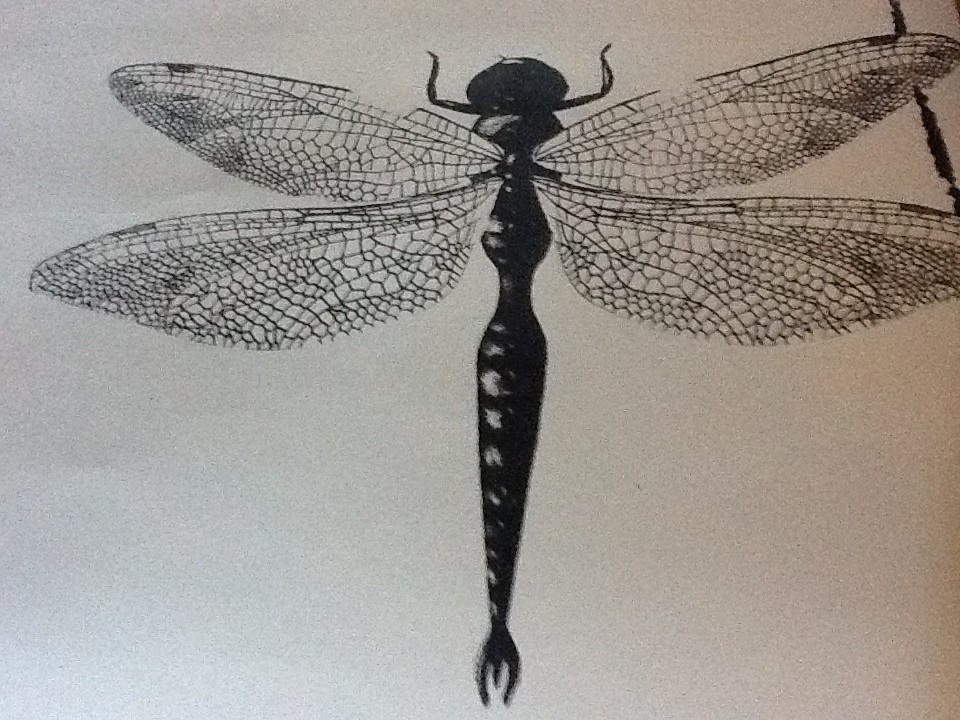
I bought some wallpaper the other day. Just four yards of it.  It has enormous dragonflies on it–each one is 2 feet across, a pen and ink drawing done in exquisite detail.

Don’t ask me why.

When I was young I was told that dragonflies sewed your mouth shut.  I can clearly remember knowing that and believing it as a child. Yet when I ask other people, no one else had ever heard of such a thing.  Is it a ethnic thing that came from my parents? Was it just an off-the-cuff remark that some joking adult told me and which I always believed?  I don’t know.

I mentioned it to a woman I worked with once. She had never heard of their sewing mouths shut, but she told me a much, more horrific tale about her and dragonflies.

She was a little girl around seven or eight and there was a copse of trees behind the house where she lived, ringed by a swatch of tall, wild grass.

One day when she was playing in or walking through the high grasses, three slightly older boys molested her.  They dragged her to a clearing in the woods and the weapon they used was a dragonfly.  They pinned down her arms and legs and waved the dragonfly in front of her face while they groped her and de-pants her. For her, a dragonfly meant much more than a silly wives’ tale about sewing children’s mouth shut.

What more can one say?

And where are those boys? What have they become? Do the remember that hell they visited on that little girl?

I have outgrown my fear of dragonflies–in fact, now I find them beautiful and graceful.  But I am sure that that young girl, now a woman in her 60s, never has.

Women Writers and New York City–or all writers and everywhere.

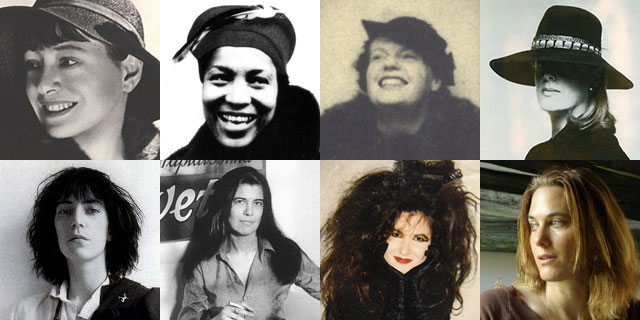
Top row: Dorothy Parker, Zora Neale Hurston, Shirley Jackson, Gael Greene.
Bottom row: Patti Smith, Susan Sontag, Tama Janowitz, Kate Christensen.

I have a niece who is struggling in New York City to make it as a writer…and she is doing pretty well (see my blogroll and click on “Courtney Gillette.”) Nevertheless, it is a struggle. I have a friend whose son Brendan is carving his way as a comic/comedy writer–not the easiest of niches to crack into–and he is making headway. They are just two of thousands who go to NYC with dreams of making it big and –more power to them–they have the drive and determination to do so.  But it is not just New York, it is cities around the world where people intent on making something new, struggle to survive and to get their work out…and hopefully recognized.  So I thought of both of them–Courtney and Brendan–when I read this article this morning.  The article itself is from mid-April, but it is a fun piece highlighting some of my favorite people and writers.

Anyway, here is the article from a site called AWL. It tracks what particular writers arrived New York with before they “made it” and adjusts the value of their belongings and purchases for inflation.  It is a fun piece that ranges from Dorothy Parker and Zora Neale Huston to Patti Smith and Tama Janowitz:

What it Cost Eight Women Writers…

And speaking of Patti Smith, I have been on a Patti Smith kick for over a year now.  One day in December 2010, I actually received three separate copies of her memoir, Just Kids and of course read it in a night and then began giving out copies to everyone. Then I began to reacquaint myself with her music. (Her video singing “Helpless” with Neil Young is powerful.)

Just last week a friend sent me this new Patti Smith video/song. It’s about April and poetry and fools.  Enjoy.