Friday Film Review: A Dangerous Method


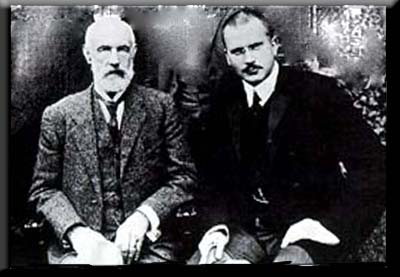
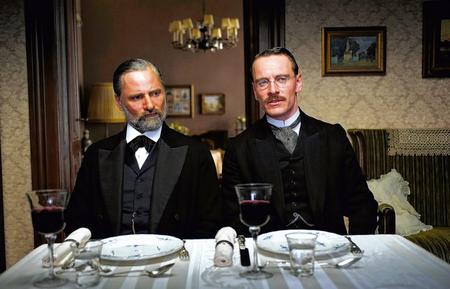
After many missteps and thwarted plans, I finally got to see A Dangerous Method. I don’t know how accurate it was–though it seemed so– but to watch Freud and Jung working together, fencing with each other’s ideas and techniques, is intriguing. History usually sets them in direct opposition to each other–and they saw themselves that way as well after their infamous break–but I see them as simply taking and following two different paths. Jung deals with humanity at large, with myths and archetypes; Freud with the individual, with the conscious and the sub-conscious.

The film is marvelous, hinting at what Jung is about to discover, what he begins to question about Freud; marvelous with Sabina Spielrien talking about anima and animus to Jung, arguing eros and thanatos with Freud; and ominous with the small undertones of the fomenting friction between Jewishness and Aryanism: Wagner’s Siegfried and Spielrien’s Judaism, Jung’s dream of an apocalypse coming from the north and washing Europe with blood, Freud’s concern that his work will be disparaged as the perversity of Jewish doctors.

Jung, it seems, had to break with Freud, just as the son has to break with the father. In fact, Jung’s father complex with Freud seemed quite evident. Although we are dealing with a film and the demands of drama and a story-arc, Jung seems much more fragile than I had imagined. The film ends with his seeming quite shattered–which historically he was–but it was still surprising to see such a towering figure so broken.

All in all, I loved it…and it is sending me to find the book it was based on by John Kerr, plus anything at all on Sabina Spielrien–a relatively forgotten figure in the beginnings of psychoanalysis.

“Modern Love”

The word “modern” is such a subjective term.  The 19th century poet, George Meredith, wrote a poetic sequence of 50 poems and entitled it Modern Love. The poems, each having 16 lines in 4 rhymed quatrains,  describe the relationship between a man and his wife.  It is “modern” for him because it is describing his current life in the 1860s.  Yet, it is extraordinarily modern to us, in that it is timeless.  It doesn’t seem filtered by the past, but emotionally contemporary. The distant couple, the repressed emotions, the sleepless night, these all seem to be taken from the late-20th-century, early -21st. I swear I have seen countless movies where a modern woman and modern man lie on their backs, thinking, wishing, wondering–the very emotions that Meredith attaches to his “modern lovers.”  All it needs is a plaintive soundtrack by  Bonnie “Prince” Billy.

Here is the first poem in the sequence.  Notice the dread, the sadness, the angst; it seems all so very real, very contemporary.

By this he knew she wept with waking eyes:
That, at his hand’s light quiver by her head,
The strange low sobs that shook their common bed                                             
Were called into her with a sharp surprise,
And strangely mute, like little gasping snakes,
Dreadfully venomous to him. She lay
Stone-still, and the long darkness flowed away
With muffled pulses. Then, as midnight makes
Her giant heart of Memory and Tears
Drink the pale drug of silence, and so beat
Sleep’s heavy measure, they from head to feet
Were moveless, looking through their dead black years,
By vain regret scrawled over the blank wall.
Like sculptured effigies they might be seen
Upon their marriage-tomb, the sword between;
Each wishing for the sword that severs all.
——-
(For those who like the “biographical” strategy, check out George Meredith’s life. It makes the poem all the more poignant.)