“Creativity is allowing yourself to make mistakes. Art is knowing which ones to keep.”
Scott Adams

Trash
illustration by jpbohannon © 2013
Trash
illustration by jpbohannon © 2013
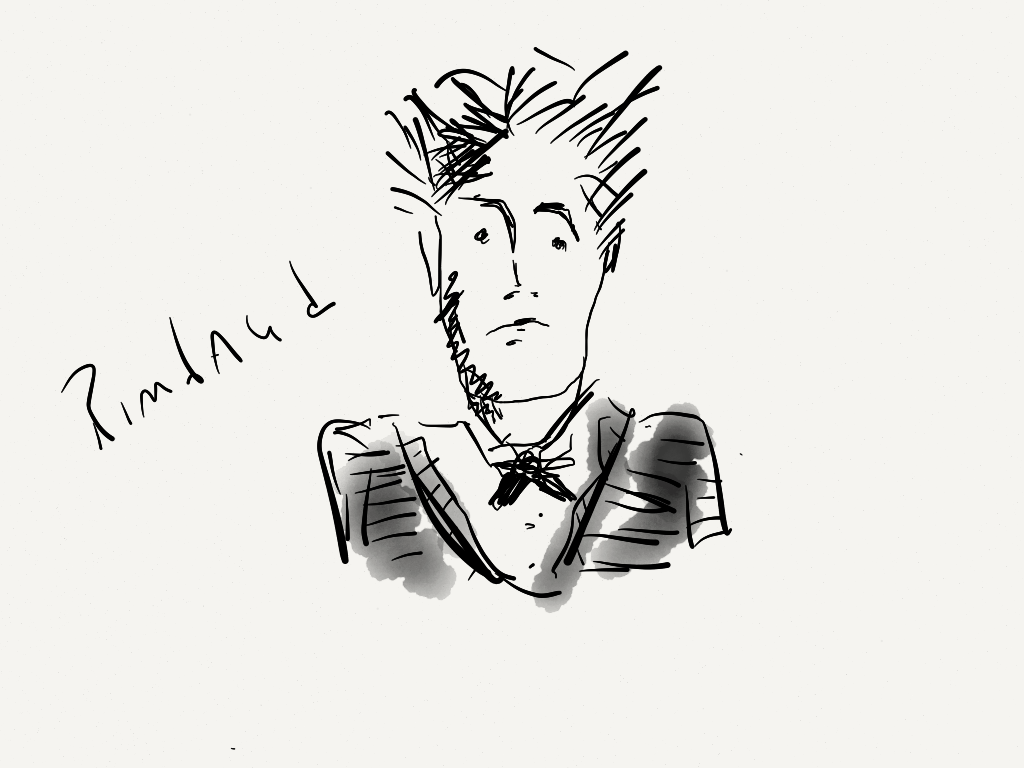
Rimbaud
illustration by jpbohannon © 2013
A colleague came up to me with a problem–a problem with some unruly boys who had been displaying a growing disrespect towards her, coupled with a sophomoric sexism that went beyond their adolescent asininity and a smattering of racism. She then went on to say that to make matters worse, they were also very good writers. I wondered to myself if what she said was not necessarily atypical–that their innate creativity is being strangled by the dysfunctions of the modern educational system and that that is one cause of their intractability.
To make the point, I told her, I wouldn’t want to have taught Rimbaud.
Ah, Rimbaud, the boy-child terror who created haunting, mesmerizing verses until he was 21 and then quit to become a businessman, to dabble in gun-running in Africa, and to even try to join the U.S. Navy. But whatever he did from that point on, he had quit writing and refused to talk about it thereafter. Yet in those five or six years in late adolescence, he cut a swath of creativity and destruction, of love and violence, of intelligence and stupidity–and blazed into the pantheon of world poetry.
In actuality, however, Rimbaud was in fact a fine, model student. While he was in school, he usually walked away with the academic prizes given out at the end of a school year. He wrote poetry in in his native French, as well as in Latin and Greek, mature verse, some of which is still anthologized. Indeed, he was a stellar student. But then he quit school.
When he was still sixteen–and with the encouragement and support of the older Paul Verlaine whom he had enamored with some verses –Rimbaud first ran away to Paris. There he began a meteoric life of debauchery, anarchism, promiscuity, violence, substance abuse–and the most intense poetic creativity.
And like a meteor, Rimbaud burned out quickly. His intense and volatile love affair with Verlaine ended with Verlaine shooting him twice in the arm. Verlaine was arrested and served two years in prison.
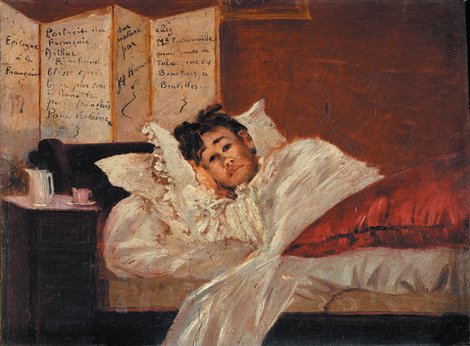
Wounded Rimbaud by Jef Rosman, 1873
When Verlaine was released from prison, Rimbaud handed him a sheaf of loose papers which would become Illuminations, his last major work. Rimbaud was but 21 years old. He was already an old poet. Verlaine had published his FIRST book at 21. Rimbaud was finished by then. (A series of prose reflections, Illuminations is akin–in its intent–to the epiphanies that Joyce gathered –at the beginning of his career, however. )
Here are some 4 stanzas from Rimbaud’s 100 line poem The Drunken Boat (Le Bateau Ivre). He was sixteen when he wrote it!
But now I, a boat lost under the hair of coves,
Hurled by the hurricane into the birdless ether,
I, whose wreck, dead-drunk and sodden with water,
neither Monitor nor Hanse ships would have fished up;
Free, smoking, risen from violet fogs,
I who bored through the wall of the reddening sky
Which bears a sweetmeat good poets find delicious,
Lichens of sunlight [mixed] with azure snot,
Who ran, speckled with lunula of electricity,
A crazy plank, with black sea-horses for escort,
When Julys were crushing with cudgel blows
Skies of ultramarine into burning funnels;
I who trembled, to feel at fifty leagues’ distance
The groans of Behemoth’s rutting, and of the dense Maelstroms
Eternal spinner of blue immobilities
I long for Europe with it’s aged old parapets!
(From Arthur Rimbaud, the Collected Works, translated by Oliver Bernard)
So the question remains “Would I want to have taught Rimbaud?” I am not sure. I am not sure of myself. Rimbaud–the excellent student, remember–was fortunate to have an exceptional school teacher and mentor, George Izambard, who fostered and encouraged the boy’s talent, gave him free access to his personal library and pushed him towards greatness. That is a big responsibility, to see and encourage greatness.
But in a large way, that is the true nature of teaching–whether it is a future Rimbaud or not. For how are we to know?
The rest of that line is “he had so many children he didn’t know what to do.”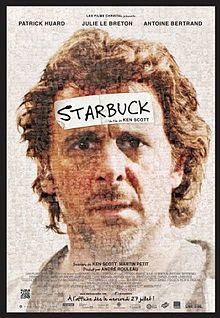
Even Mother Goose could not have imagined the number of children that David Wozniak (Paul Huard) fathered. As a young man, Wozniak had visited a sperm bank close to 700 times in a 23-month period. At $25/35 dollars a visit, it was a nice source of income (and an implied source of great generosity later in the film). Unknown, to David, however, was that his sperm was very strong and very effective. From his nearly 700 donations, 533 children were born. And 142 of them have found each other, have united and are filing a class-action suit to discover who is the man behind the Agency’s alias known as STARBUCK.
Ironically, the day that David learns he has 533 children–most now in their late adolescence, early twenties– his girlfriend tells him she is pregnant. She also tells him that she wants nothing to do with him and does not want him to have a role in the life of their child. It is the film’s narrative that has Wozniak gain paternal responsibility through identifying and relating with the numerous children he already has.
Huard’s performance is endearing. In a lumbering way, he reminds one of a young Gerard Depardieu. He is a bit of a sad sack, a bit of a screw-up, a 40-something slacker, and the least effective of his father’s sons who all work together in a butcher shop. He is being hounded by loan sharks, discarded by his girlfriend, and advised by his cherub-faced croney who has let his legal license expire.
And then he finds out he is a father…and then some. The delight of the film is when Starbuck annonymously tracks down various of his children. There is a nationalsoccer star and a busker in the metro, a promiscuous gay man and unstable heroin addict, a son with severe disabilities and a daughter who makes heads turn when she walks down the street. Wozniak embraces them all and becomes part of their world–even to the point of allowing one “goth” son to live with him. Yet none of them know who he really is.
And as charming as Huard is, his lawyer friend, Antoine Bertrand, is a delight. Himself harried by his own large family–one loses count of how many school lunches he must make in the morning–haunted by his mother’s lack of faith in him, and nervous about taking on a case that is gaining in notoriety, Bertrand is both gentle and loveable. And like his friend, he too is a bit of a sad-sack, nearly ruining things completely as victory surrounds closes in.
Written by Ken Scott and Martin Petit and directed by Scott, Starbuck is a light film with a very good feeling. Towards the end, there is even a “group hug,” which, as cheesy as it may sound, works wonderfully in capturing the joyful spirit of the entire movie.

Montreal looks wonderful, and, as a plus, the soundtrack is infectious with original music by a French-Canadian singer named David Giguere. My next quest is to find more of his music.
The film was made in 2011 but is just now being shown in the U.S. A “remake” has already been spawned, entiltled Delivery Man, starring Vince Vaughn and scheduled for release in October 2013. Like so often happens, I can’t imagine the remake capturing the same charm as Starbuck. So here’s the trailer of the original. Enjoy it:
[youtube.com/watch?v=_8XKccuB_ao]As many of you know, I am teaching a course in modern Irish literature this term to a group of 18-year old American boys. As an American classroom, it is filled with various ethnicities and races. And so, I can never assume that they know what I–or the authors they are reading–are talking about. And so when we began Martin MacDonagh’s Lonesome West, I knew it was going to be a challenge to get them to enjoy it.
Because, when all is said and done, that’s really the purpose…to get them to enjoy what they are reading. And surprisingly, that is a difficult thing for them to do. Sure they loved saying the word “fek” when we read the play out loud–and which sometimes occurs twenty-five to thirty times on a page. (One student told me he loved the word so much he started saying it around the house. I advised him that maybe he should rein it in a bit.)
But surprisingly, they were too uptight to enjoy the humor…or even to get it! There is a great line where Father Walsh Welsh — even that’s funny: I explained that this character has appeared in three separate plays now and that no one ever gets his name right, so they continually call him both. Stone faces in front of me. … anyway, there’s this great line where Father Walsh Welsh is anguishing about his failure as a priest. Coleman tries to reassure him:
Ah there be a lot worse priests than you, Father, I’m sure. The only thing with you is you’re a bit weedy and you’re a terror for the drink and you have doubts about Catholicism. Apart from that you’re a fine priest. …
I had to explain that that was funny. I had to explain that Girleen’s blatant attempts at seduction, her outrageous dirty-mindedness, and her falling in love were funny. (The pathos of her ending was a whole other story!) That Coleman’s constant ribbing of Fr. Walsh Welsh about the priest scandal in Ireland was funny. And that a small village where a father has been murdered by his son, a mother by her daughter, and a wife by her husband is a funny world indeed, especially when the smashing of holy figurines or stealing poteen is considered a more serious crime.
They were fine in talking about themes of redemption and reconciliation, in tracking down and explaining symbols, and analyzing character. But they stumbled upon the humor. And when all is said and done, that might be more important than all that the other stuff.
 And so I thought I would relieve their reading by showing them MacDonagh’s Oscar winning short film Six Shooter. Unlike most of MacDonagh’s work which takes place in the west of Ireland, this takes place in southeast Ireland, particularly on a train to Dublin. A man is returning from hospital where his wife has just died that morning. He boards a train to go home and sits next to a young twenty-something who is a bit more than strange and possibly deranged. The boy’s patter, aggressiveness and nonsequiturs are amusing, uncomfortable, and awkward. But they are also, at times, bizarre and hilarious. But maybe not to a group of high-school Americans. Suffice it to say that by story’s end we have seen a cow explode, a rabbit get shot, a woman throw herself off a train, a character gunned down by police and a man fail at his attempt at suicide. And that is the violence that happens just on screen. (I explained to them that MacDonagh was a combination of Quentin Tarentino, David Mamet, and John Millington Synge.)
Anyway, if a short movie that moves the cartoonish violence of Tarentino into the idyllic countryside of the Irish coast sounds appealing, then here it is below. It did win a 2006 Oscar in movie, though I don’t know if that held any sway with my boys. Here it is:
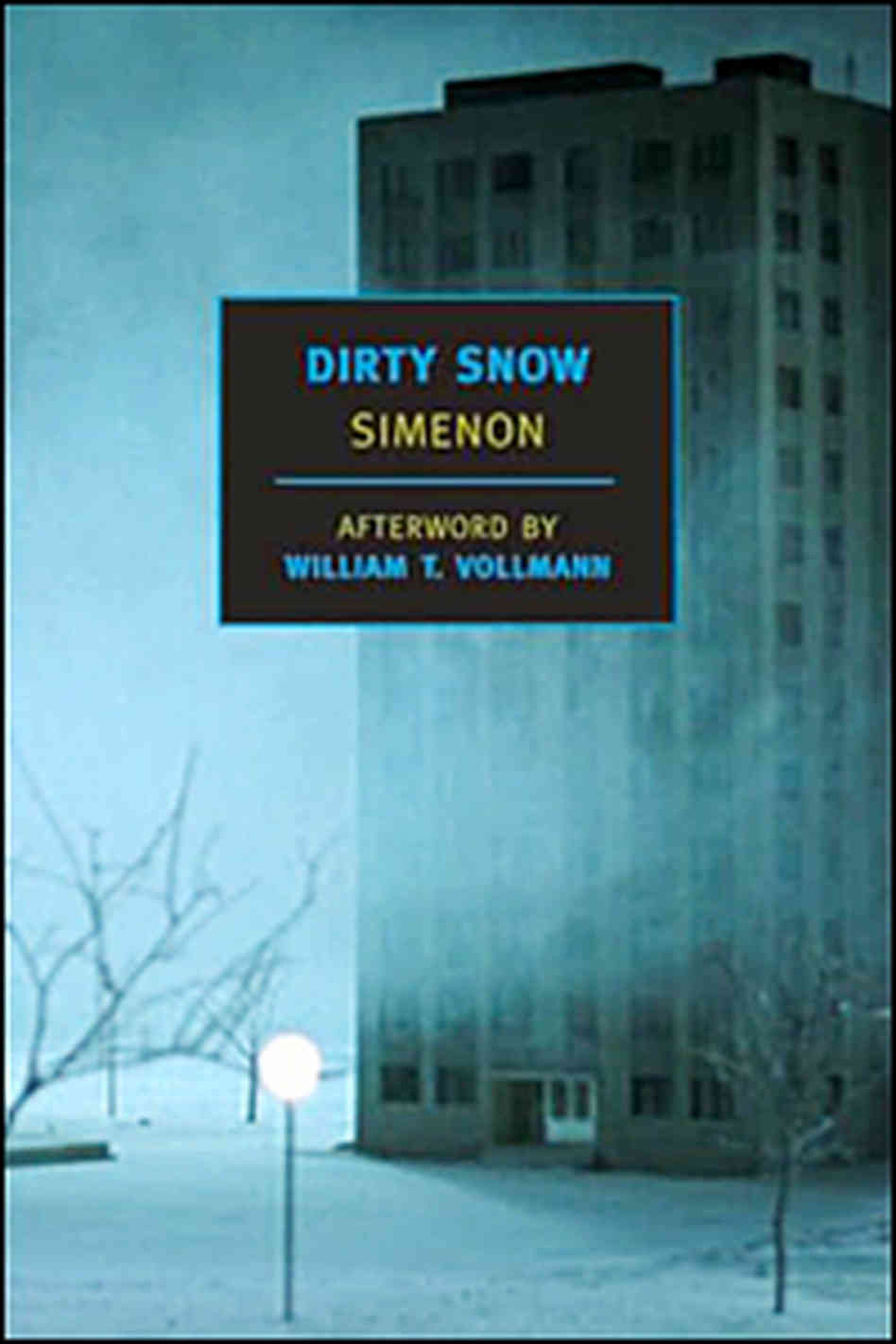
A colleague of mine passed on a book that he liked very much. Dirty Snow by the prolific Belgian writer, George Simenon. I had read several of Simenon’s detective novels, gritty tales that featured the Parisian detective Maigret. The Maigret novels–I believe there are over fifty of them—seemed superior to most in that genre, filled with a certain ennui and jaded acceptance that went beyond the cynical aloofness of his American counterparts or the aloof cynicism of his more modern offspring. And to be honest, they were good reads.
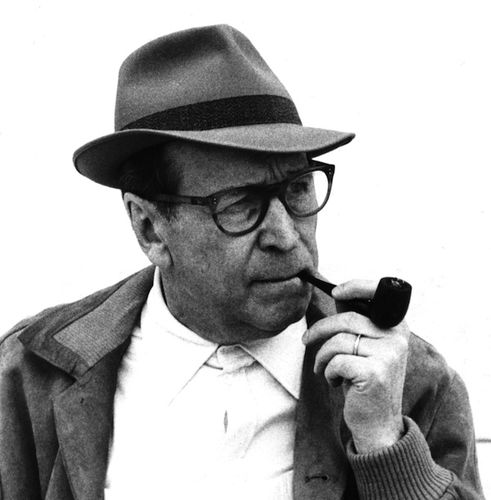
George Simenon
Although I had read only the Maigret novels, I knew that Simenon wrote other sorts of novels. I had always heard them referred to as “philosophical” novels, though the French label them as “psychological” novels. And the French are closer to the truth, here.
And when my colleague passed on to me Dirty Snow, he did so with the caveat that it was “extremely grim” although oddly humanistic.
Dirty Snow is the story of Frank Friedmaier making his way through his occupied city. We never know who the occupiers are and where the city is. When he is imprisoned, his captors, his location, and his crime are never identified. All of this, gives the novel a certain Kafkaesque feeling. And although time moves forward throughout the seasons, there seems always to be piles of soiled, stained, and dirtied snow.
And yet it was Crime and Punishment that I thought of immediately. Frank–who may be the most amoral, sociopath I have come across in my reading, and I know Burgess’s Alex and Ellis’s Bateman–begins the novel looking to kill his first person. There is no reason for, no gain from this murder–it is, as he says, like losing his virginity: “Losing his virginity, his actual virginity, hadn’t meant very much to Frank. He had been in the right place. … And for Frank, who was nineteen, to kill his first man was another loss of virginity hardly any more disturbing than the first. And like the first, it wasn’t premeditated.” Like Raskolnikov in Crime and Punishment, he needs little push to kill his victim. Yet, there the similarity ends. For Raskolnikov punishes himself, mentally, emotionally, spiritually and psychologically for the crime he committed. Frank feels nothing. And soon he kills again…an old woman in his childhood village who recognized him in the course of a burglary.
But the murders are not his greatest crime. That is reserved for the sweet and loving Sissy who lives across the hall from the brothel that Frank’s mother runs and where Frank lives. (Sissy mirrors very closely Raskolnikov’s Sophia in her love and faithfulness to Frank.) Frank’s relations with women are brutal at best–indeed all the women in the novel seem mistreated one way or another. He takes full advantage of his mother’s prostitutes, coldly, quickly and unemotionally, and this is the way he treats Sissy as well, deceiving her into a situation where she is nearly raped by his drinking associate.
One might say there is no reason for Frank’s viciousness, but that would be inaccurate. There is no “motive,” no “purpose” for his ferocity. But there is a reason, and Simenon attempts to suggest it subtly. Frank’s mother abandoned him to a wet-nurse so she could “ply her trade” and visited only occasional. He never knew his father, only the brutality of both life and the State. Two men are offered as father surrogates in the novel: one, a Maigret-like inspector who turns a blind eye to Frank’s mother’s occupation and who very well may be his biological father and Sissy’s father, Holst, who Frank is drawn to from the beginning, who sees Frank in the alleyway on his first kill, and who offers him forgiveness at the end.
But many men have similar upbringings and few turn out as nihilistic, amoral, and unfeeling as Frank. To his interrogator he says at the end: “I am not a fanatic, an agitator, or a patriot. I am a piece of shit.” There is nothing. Yet the flip side of that is that there is nothing the State offers either. They have not arrested him for the murders or the burglary. They have brought him in, they torture him merely for information. And here, in the claustrophobic room where he is questioned, one remembers a similar room–Room 101 in Orwell’s 1984. But Frank is no Winston Smith either; there is no romantic dream of something better, no fervid belief in the ultimate progress of what is right. There is only Frank, solipsistic and brutal Frank.
Simenon’s novel is fascinating. His hero is repellent. And I can’t stop thinking about neither it nor him… It’s sort of like wearing wet shoes, soaked through by dirty snow.
The Official Web Site of LeAnn Skeen
Grumpy younger old man casts jaded eye on whipper snappers
"Here is my secret. It is very simple: It is only with the heart that one can see rightly; what is essential is invisible to the eye.."- Antoine de Saint Exupéry
Of writing and reading
Photography from Northern Ontario
Musings on poetry, language, perception, numbers, food, and anything else that slips through the cracks.
philo poétique de G à L I B E R
Hand-stitched collage from conked-out stuff.
"Be yourself - everyone else is already taken."
Celebrate Silent Film
Indulge- Travel, Adventure, & New Experiences
Haiku, Poems, Book Reviews & Film Reviews
The blog for Year 13 English students at Cromwell College.
John Self's Shelves
writer, editor
In which a teacher and family guy is still learning ... and writing about it
A Community of Writers
visionary author
3d | fine art | design | life inspiration
A Creative Life
 j. p. bohannon