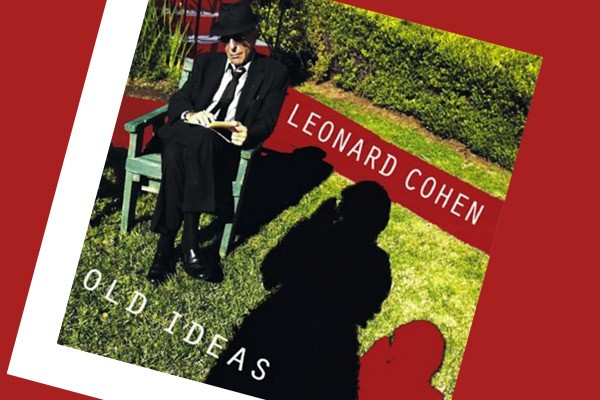
 His voice is unmistakeable, his lyrics are second to none. And I’m not talking Dylan here. For nearly as long as Dylan has, Leonard Cohen has been creating incomparable songs–songs that deal with pain, sexuality, religion, the miscarriages of history, the ravages of love, and finality. And now at 77 years old, Cohen seems even more focused on the finality.
For instance, “Going Home,” the first song on his new album Old Ideas, is a description of a “lazy bastard living in a suit” named Leonard. In the realization that he is “going home,” the fictional Leonard is wishing he had had a user’s manual for living, for living in defeat.
(If you know little about Leonard Cohen, you might be unaware that his manager did a “Bernie Madoff” on him and left him completely broke which is why he is touring the world and putting out new stuff at this stage in his life. Unfortunately, he has to. Fortunately, it is still very good stuff.)
The music, like so much of Cohen’s work, is often just an understated support to Cohen’s enigmatic lyrics. Simple piano or guitar set up against the words. At other times, the production has beautiful, choir-like singers (the Webb Sisters), whose voices are often in bright opposition to the darkness of his ideas. His work has frequently had the tenor of southern spirituals (cf. “Hallelujah”) and on this record, “Amen,” “Show Me the Place” and “Come Healing” follow suit, while “Crazy to Love You” recalls the acoustic guitar work of Cohen’s early days.
But the music is ALWAYS secondary to the words. How heartbreaking is a love song that begs “I know you have to hate me/But could you hate me less?” It is this heart-wrenching sadness, the jaded philosophy that makes Cohen so beguiling. And I find that in his old age, this jaded attitude is even more compelling–for underneath it all, there is something hopeful, poetically hopeful in the continuance of things. In a odd way, Cohen’s complaining about the world and its injustice implies that he wants to see it better, that it can be better, that it will be better.
Having Leonard Cohen’s voice in the world, having his striking words propped up by the most simple instrumentation, makes my world better. Hallelujah!
 j. p. bohannon